November 5, 2026
The energy sector is increasingly interconnected with finance
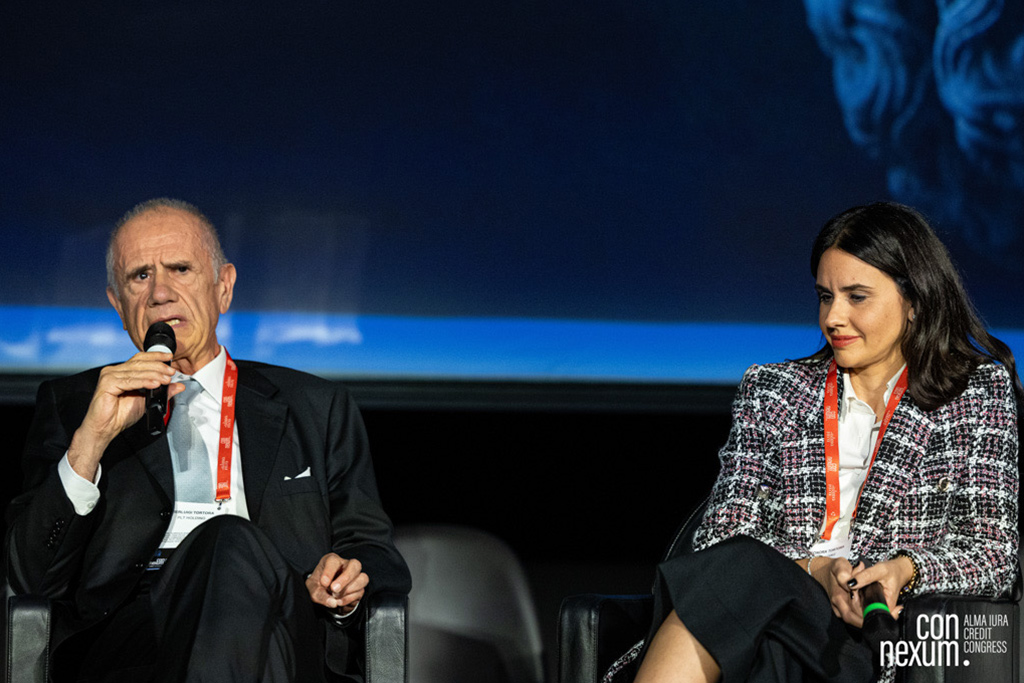
Pierluigi and Eleonora Tortora speak: leading members of the Cesena-based family that founded PLT, one of Italy’s foremost renewable energy groups, before investing in MPS, where the family played a decisive role in securing Luigi Lovaglio’s reappointment as CEO. It has now become a major player in the ongoing reshaping of the banking sector
The energy sector is increasingly interconnected with finance. Large renewable energy plants require ever greater investments over long periods of time. As a result, the success of energy transition projects increasingly depends on the effectiveness of the project financing arrangements that make them possible.
It was therefore a kind of “fatal attraction” that prompted the Tortora family’s PLT Holding, led by Cesena-based entrepreneurs who have been active in renewables for years, to link its fortunes with those of finance. It entered the sector quietly in 2022, investing in Mediobanca shares part of the proceeds from the sale of PLT’s renewable energy plants to Eni’s Plenitude. Then, by tendering those same shares into MPS’s cash-and-share takeover offer for Mediobanca in 2025, PLT became a significant shareholder in the Siena-based bank, with more than 1% of its capital. Subsequently, by putting forward the slate of candidates supporting Luigi Lovaglio’s reappointment as CEO, a family previously known for its discretion found itself in the national media spotlight, becoming an important player in the banking sector’s ongoing consolidation.
To understand the underlying reasons for the decisions made in recent weeks, Be Bankers asked Pierluigi Tortora, the group’s founder, Chairman and CEO, and Eleonora Tortora, CFO and Investor Relations Manager, to retrace the stages of this integration with finance and explain the thinking behind it.
How did the decision to enter finance come about? Was it primarily driven by a need to diversify your investment portfolio, or by the belief that finance has become increasingly important for entrepreneurs operating in the energy business?
Pierluigi Tortora (PLT) The decision stemmed above all from a principle I consider central to entrepreneurship: capital does not necessarily have to be reinvested in the sector in which it was generated. It should be allocated wherever the best opportunities to create value can be identified.
For us, the sale to Plenitude marked the completion of a very important phase in our industrial development, but not a departure from energy, which remains one of the Group’s main areas of activity. At the same time, the transaction gave us substantial resources and enabled us to begin a new chapter in our history.
Our entry into finance should be understood within this broader development. It was neither simply a matter of diversifying our assets nor a shift from industrial entrepreneurs to financial investors. I still consider myself first and foremost an entrepreneur. Even when we invest in a bank, we try to think from an industrial perspective: the quality of management, the strength of the business plan, and the ability to generate cash and value over time.
But finance is not our only new direction. We are also increasingly developing our real estate activities, which are becoming a fully fledged new pillar of the Group. Here too, we are not interested in a purely financial or speculative approach: we seek transactions in which value can be created through asset development, transformation and management.
At the same time, we are working on the Group’s international expansion. I believe this is a natural consequence of our evolution: once a business reaches a certain scale in terms of capital and organisation, restricting its horizons to the Italian market alone would mean passing up a significant share of the opportunities available.
We therefore want to strengthen our ability to invest and operate outside Italy, while maintaining the same discipline with which we have built our businesses at home.
Energy, finance and real estate are thus becoming three important components of a more diversified and increasingly international Group, united by the same philosophy.
Rather than diversification, I would therefore describe this as entrepreneurial capital allocation. We do not want to become a financial holding company that merely spreads investments across different asset classes. We want to remain entrepreneurs, choosing sectors, projects and people we believe in and contributing, wherever possible, to long-term value creation.
With hindsight, you caught a particularly favourable cycle for the banking sector. Do you believe the decision to invest in banking has proved particularly effective?
PLT The cycle certainly helped us, but it would be simplistic to attribute the results solely to favourable interest rate trends or conditions in the banking sector. When we began investing, many Italian banks were emerging from difficult years and were trading at very low valuation multiples.
We saw something different: substantially repaired balance sheets, greatly improved asset quality, strong capital levels, and an ability to generate profits that, in our view, the market had not yet fully recognised.
Rising interest rates certainly accelerated this process, but Italian banks have also become structurally stronger and more efficient. That is why I regard our investment in banking as a very positive decision, not only financially, but also because it has given us an insider’s understanding of a sector that is fundamental to the country’s economy.
We intend to continue operating in this sector with the same approach: rather than chasing short-term market movements, we seek situations where we believe there is a tangible opportunity to create value over the medium to long term.
What surprised you most about banking and finance as you entered a sector different from the one in which you had built your entrepreneurial experience?
Eleonora Tortora (ET): Throughout my professional career, I have always worked with the banking system, thanks to the support that all the leading financial institutions have provided for our business plans over the years. I have seen how it has evolved and reached a significant level of expertise. I have come to appreciate the skills of the people working in it, as well as their innovative spirit and willingness to support us in projects that were new to the sector.
Over the past few months, I have had the opportunity to observe the banking system from a privileged vantage point. I have seen how it too “thinks” in industrial terms, with a medium- to long-term perspective, and how essential it is to build investor support through continuous, transparent and effective engagement: communicating projects and objectives credibly and establishing a relationship of trust, particularly when it comes to delivering on promises. I have found great passion and a strong sense of belonging among the people who work in it. That is probably what struck me most.
What criteria do you now use to allocate capital between industrial and financial investments?
ET: For us, the distinction between industrial and financial investment is not so clear-cut. With industrial investments, we naturally have greater scope to influence value creation directly; with financial investments, that scope is more limited. But our approach is to bring an industrial mindset to financial investments too: understanding thoroughly what we buy, identifying its value drivers and, wherever possible, the levers that can help it grow over time.
We therefore assess every investment from a Group perspective: we ask how it fits alongside our other assets, whether there are complementary elements and, above all, whether it helps build a balanced and valuable portfolio. The aim is not simply to hold different investments, but to hold investments that serve different purposes and, together, make our capital base stronger and more resilient.
You have been among the key players in a period of profound change in Italy’s financial system, marked by the developments involving Mediobanca and MPS. Now that events have settled somewhat, how do you assess that experience? Do you believe Mediobanca’s traditional role as a point of reference for Italian entrepreneurs still serves a purpose, or do you think more open and competitive models are better suited to today’s economy?
PLT: It was a very important experience because it led us to fully exercise the role and responsibilities of a shareholder.
I have great respect for Mediobanca and for what it has represented in Italy’s economic history. For many decades, it was one of the central institutions shaping the balance of power within Italian capitalism. But economic and financial models evolve, and I believe that today a shift towards a more open, contestable and competitive system is inevitable.
I believe a shareholder should do more than simply hold a stake. If they believe in a business strategy, they must take responsibility for supporting it; if they think it can be improved, they must have the courage to express their position. That is what we did at MPS.
We believed in Luigi Lovaglio’s work and in the bank’s transformation when the market’s assessment was still very cautious. This was not personal support, but recognition of the results achieved and the quality of a business strategy that, in our view, was restoring MPS’s financial strength, profitability and strategic direction.
Subsequent results confirmed that assessment.
We have applied the same criterion to the subsequent transactions involving the Italian banking system: assessing them on their ability to create industrial value, rather than on the system’s historical balance of power.
I therefore do not think the issue is whether one is for or against Mediobanca, or whether old finance should be set against new finance. Rather, I believe that strategies, results and execution capabilities should now take precedence.
For an entrepreneur, this is quite natural: ultimately, capital should be entrusted to the people and projects that demonstrate they can put it to the best use.
As energy entrepreneurs, you are currently active in electricity and gas distribution and in the wind energy business. Do you see significant prospects for hydrogen production from renewable sources and, more generally, which technologies do you consider most promising for the next phase of the energy transition?
PLT: I take a pragmatic view of hydrogen. I believe it can play an important role in certain industrial sectors that are difficult to electrify, but I do not think it can provide a universal solution in the short term. The key issue remains the economic competitiveness of the entire value chain.
In my view, the energy transition is entering a more mature phase. After years in which attention focused mainly on expanding installed renewable capacity, the challenge will increasingly be to integrate that generation effectively into the system.
That is why I see major opportunities in renewables, certainly, but also in energy storage, in grid digitalisation, in smart demand management and in all the technologies that make inherently intermittent energy dispatchable and usable.
The real challenge is not simply to produce more renewable energy: it is to build an energy system capable of delivering it when needed, at competitive prices, while maintaining grid security and stability.
In energy too, we are paying increasing attention to international markets. The energy transition is now a global process, and investment opportunities, technologies and capital move across increasingly interconnected markets. International expansion therefore represents not only an opportunity for growth, but also a component of the Group’s future strategy.
We continue to view the energy transition with great interest, but with one very simple criterion: technologies must be sustainable not only environmentally, but also industrially and economically.
In my opinion, the next phase of the transition will hinge on this balance.
Are energy and finance set to become ever more closely integrated in the coming years? And what does the banking system currently lack in order to support the energy transition and long-term investment more effectively?
PLT and ET: We believe energy and finance are already deeply interconnected and will become even more so in the years ahead. The energy transition requires enormous investment, with long time horizons and returns that must be assessed over many years. Without a financial system capable of supporting this transformation, the goals of the transition risk remaining just that: goals.
The banking system has already made important progress. In our view, however, it needs to further develop its ability to assess projects from an industrial as well as a financial perspective. A renewable energy plant, an energy storage system or energy infrastructure has characteristics, risks and payback periods that differ considerably from those of a traditional investment.
In this respect, we believe ever closer dialogue between banks, businesses and institutional investors is necessary. Banks can play a fundamental role, but they cannot meet the transition’s entire financing needs on their own. Capital markets and long-term savings will also need to be mobilised to a greater extent.
There is another aspect we consider essential: the stability of the regulatory framework. For investments with a lifespan of twenty or thirty years, the predictability of the rules is almost as important as the cost of capital. If regulations, permitting procedures or economic conditions keep changing, financing new projects inevitably becomes more difficult. The energy transition is therefore not just a technological challenge. It is simultaneously an industrial, financial and regulatory challenge.
Perhaps it is precisely our experience, first in energy and subsequently in finance, that has made us particularly aware of this connection. Capital must be able to find sound industrial projects and support them for as long as it takes to turn them into value. This ability to bring together capital, industrial expertise and a long-term vision will be one of the decisive factors in European competitiveness in the coming years.